When the food is not doing what it should
These guides distinguish process signals from simplistic clock- or temperature-only answers. They connect a cooking problem to cooker control, probes, timing, recovery, and the next cook.
Start with the complete plan
Cook plans with room to adapt
For a full brisket, ribs, chicken, or pork-shoulder cook, begin with the planning and finish framework. Return here when a specific signal needs diagnosis.
Start with the result
What happened to the food
Tri-tip
Smoked tri-tip is tough
Separate an unfinished roast, an overextended high-heat finish, and a slicing decision before blaming the pellet grill or adding more heat.
Burgers
Pellet grill burgers turn dry
Keep the required safety check separate from an unnecessarily long cook, thin-patty timing, weak heat recovery, or a burger left on after it is ready.
Turkey
Smoked turkey finishes too early: protect the bird until the sides are ready
Protect a safely finished turkey without drying it out, slicing too early, or turning the wait for side dishes into an unsafe holding plan.
Salmon
Pellet grill salmon turns dry
Separate a food-safety endpoint from an overlong cook, weak heat plan, or repeated lid opening before trying to rescue dry salmon with sauce.
Steak
Reverse-seared steak has no crust
Diagnose a pale reverse-seared steak through the high-heat phase, surface condition, timing, and food-safety boundary instead of extending the low phase blindly.
Brisket
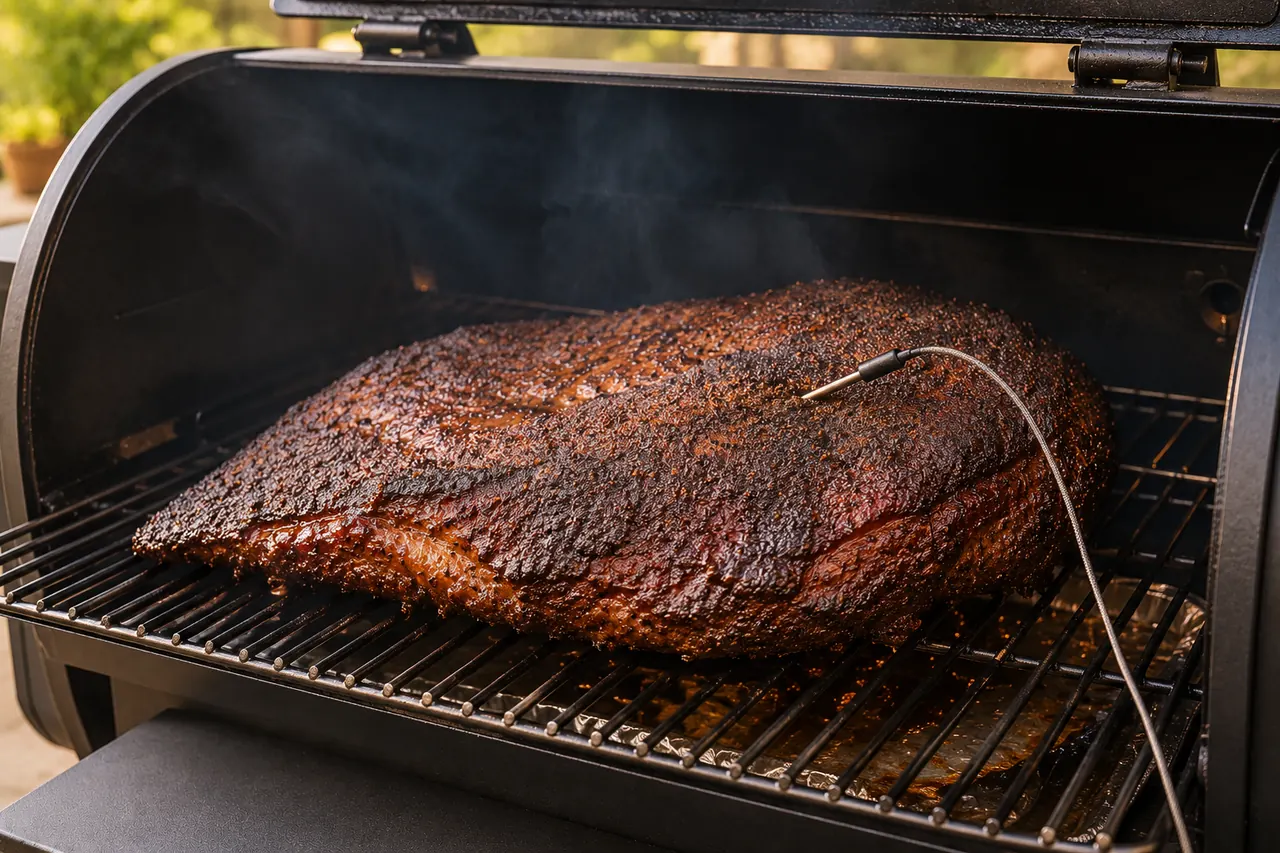
Why brisket stalls at 160°F and what to do next
Tell a normal evaporative-cooling stall from a temperature-reading, timing, or cooker-control problem.
Brisket
Why brisket turns dry after smoking
Separate a slicing, holding, tenderness, trim, or heat-management problem before trying to fix dry brisket with sauce alone.
Brisket
Why brisket is still tough after smoking
Use probe feel, cut structure, cooker stability, and rest to distinguish an unfinished brisket from one being judged in the wrong place.
Brisket
Why brisket bark is not forming
Read the surface, airflow, moisture, rub, and timing before treating a soft bark as a reason to force more heat or sugar.
Brisket
What to do when brisket finishes too early
Protect a finished brisket without slicing it too soon, confusing an early finish with a false probe signal, or turning a scheduling win into a food-safety problem.
Ribs
Why ribs are tender in one spot and tough in another
Read uneven rib texture as a doneness and thickness problem before trying to rescue it with more sauce or heat.
Chicken
Why smoked chicken skin stays rubbery
Separate a safe internal temperature from the skin texture you wanted, then decide whether heat, airflow, or timing is the limiting factor.
Pork shoulder
Pork shoulder will not pull apart even though the temperature looks done
Treat a number on the probe as one signal, then check tenderness, probe placement, rest, and the actual texture before serving pulled pork.
Cook timing
Your barbecue timeline is slipping
Decide whether the cook is truly late, merely in a normal slow phase, or being misread by an unreliable probe or cooker temperature.
Resting & holding
How long should barbecue rest before serving
Use the cut, the cook’s endpoint, and the service plan to decide what rest does for the meal instead of applying one universal number.
Service timing
Your barbecue main is ready before the sides
Turn an early-finished main into a calmer service plan without leaving cooked food in an unsafe holding zone.
No exact match yet. Start with the closest food or symptom, then note the cook temperature, probe position, texture, and service timing.